
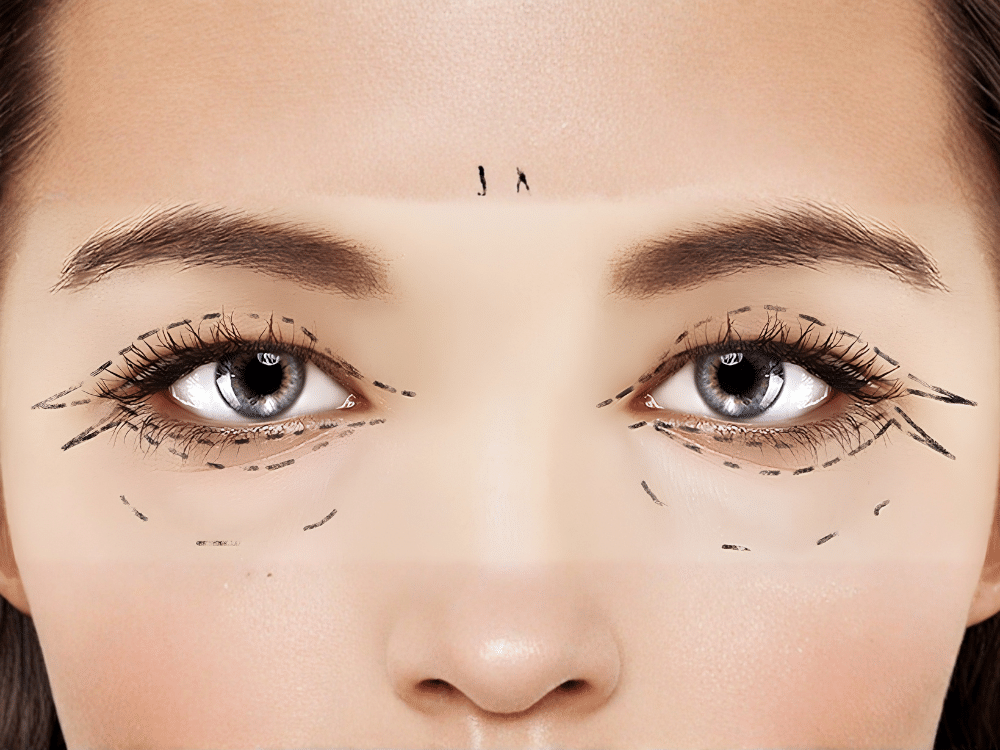
Model. Not Actual Patient.
Blepharoplasty or eyelid surgery can be performed the upper or lower eyelids, or commonly both in the same procedure. Excess skin, puffiness, and eyelid sagging are all common complaints of patients, men and women inquiring about eyelid surgery. The eyes can be considered the window to the soul, and the eyelids are the shades. Blepharoplasty can open these shades giving a rejuvenated more youthful appearance.
What Are My Eyelid Surgery Options?
Blepharoplasty, also known as eyelid surgery, is a surgical procedure that improves the appearance and function of the upper and lower eyelids by tightening muscles, contouring the eyelid, and removing or repositioning excess fat and skin. Dr. Andrew Trussler in Austin, TX can perform blepharoplasty on men and women of any age and can be performed in conjunction with other facial procedures, such as a browlift, cheek lift, or facelift.
Upper Eyelid Blepharoplasty
Upper Eyelid Blepharoplasty involves removing excess skin and sometimes fat of the upper eyelid. It can improve vision if the upper eyelid skin obstructs the upper visual fields. In women it is commonly performed in conjunction with a browlift.
Upper Eyelid Ptosis Repair
Upper Eyelid Ptosis Repair is a procedure which can be combined with an upper eyelid blepharoplasty to raise a droopy eyelid.
Lower Eyelid Blepharoplasty
Lower Eyelid Blepharoplasty involves removing excess skin of the lower eyelid, repositions fat to reduce lower eyelid puffiness, and tightens muscle and tendons in the lower eyelid to smooth and re-contour the eyelid.
Lower Eyelid Canthoplasty
Lower Eyelid Canthoplasty is an adjunctive procedure which tightens the lower eyelid and raises the outer corner of the eyelid to help support and re-contour this area.
Considerations
Blepharoplasty patients may have complaints about upper or lower eyelids, or both. Eyelid surgery can remove excess eyelid skin, reduce puffiness, and smooth the appearance of the eyelid. Patients undergoing any eyelid procedure should be healthy without any recent laser eye surgery, changes in vision, or significant eye dryness. Upper eyelid candidates typically have excess skin along the upper eyelid which can in some patients obstruct vision. Visual field examinations by an ophthalmologist can help determine if there is a medical benefit to upper eyelid surgery. The droopy upper eyelid can be corrected with a ptosis repair done through the same incision as an upper eyelid blepharoplasty. Lower eyelid malposition or retraction, commonly termed an ectropion can be corrected at the time of a lower eyelid blepharoplasty. Dr. Trussler will discuss your options regarding your eyelid surgery.
Expectations
Realistic expectations are very important in the blepharoplasty patient with defined goals in rejuvenating their upper and lower eyelids. Dr. Trussler will listen to your goals and evaluate your eyelids, cheek, and forehead in order to determine the eyelid procedure that is right for you.
Eyelid Surgery In Austin TX
The upper and lower blepharoplasty procedures performed together are typically performed under a general anesthesia with the procedure lasting between 1 to 2 hours. Upper eyelid blepharoplasty can be performed under local anesthesia in a short 30-minute procedure. This can be performed in the office in the right patient.
An upper eyelid blepharoplasty is performed through incisions in the natural skin creases of the upper eyelid. Excess skin is removed and occasionally excess fat is removed. A browpexy can be performed through this incision to define the male eyelid. Ptosis repairs can be performed through this incision as well. The fine upper eyelid incision is closed with stitches that are removed in 5 days after the operation.
A lower eyelid blepharoplasty is performed through an incision in the lower eyelid lash-line. The skin and muscle are separated in different planes with fat repositioned, muscle tightened and skin removed. Eyelid tendon tightening (canthopexy) or repositioning (canthoplasty) can be performed through this same incision. Lower eyelid incisions are closed with absorbable stitches.
All eyelid incisions are dressed only with an ointment that is safe for the eye and cooling gel eye masks.
What Our Patients Are Saying
“Dr. Trussler did an amazing job transforming me into my desired look, and all of the staff in the office are great! Thanks to him I feel great and feel more confident !”
– Anonymous
After Care & Recovery
After the blepharoplasty procedure, it is important to hydrate the eyes as the eyelids heal. Lubricating eye drops, ointments, and gel eye masks all help to maintain moisture on the eyes which can be prone to dryness secondary to the swelling around the eyelids. Swelling and bruising are common after eyelid surgery. Cold compresses and head elevation help to limit this. Eyelid surgery is more annoying than painful in its recovery.
Patients can usually return to work within two days after a simple upper eyelid blepharoplasty, but at least two weeks should be taken off after lower eyelid surgery. Strenuous activities and exercise should be avoided for at least three weeks after the surgery. Swelling and other side effects usually subside within two weeks after surgery. More prolonged recovery may be seen in patients undergoing combination type procedures like ptosis repairs and midface lifts. Dr. Trussler will give you specific instructions on how to care for your eyes after surgery.

Results of a blepharoplasty procedure are visible as swelling and bruising subside and will continue to improve for up to 6 weeks after the surgery. This procedure is designed to produce long-lasting results. While surgery cannot prevent your eyes from aging, secondary blepharoplasty is uncommon.
The scars from the blepharoplasty procedure are usually well concealed and will fade with time until they are virtually unnoticeable. The incision is hidden in the crease of the eyelid in an upper blepharoplasty, and just below the lashes in a lower blepharoplasty. Dr. Trussler may recommend lower eyelid stretching at the 3-week point of the recovery from a lower eyelid blepharoplasty to help reduce swelling and scarring.
*Disclaimer: Results and individual patient experience may vary.
Publications
-
Trussler AP, Rohrich RJ. MOC-PSSM CME Article: Blepharoplasty. Plast. Reconstr Surg. 121(1s) MOC-PS CME Collection:1-10, January 2008
-
Trussler AP, Schaub TA, Byrd HS. Endoscopic Management of the Difficult Lower Eyelid: A Review of 300 Cases. Plast Reconstr Surg. 2012 Sep;130(3): 690-699.
Frequently Asked Questions
Blepharoplasty removes excess skin and may reposition fat to improve the appearance of the eyelids. Ptosis repair corrects a drooping upper eyelid by adjusting the muscle that lifts it. Dr. Trussler may combine both procedures when needed.
Upper eyelid surgery addresses excess skin around the eyelids, while a brow lift raises sagging eyebrows that may contribute to a heavy appearance. Dr. Trussler evaluates your eyelids, brows, and forehead to determine which procedure best addresses your concerns.
Yes. Blepharoplasty can temporarily increase eye dryness as swelling affects eyelid closure and tear distribution. Patients with existing dry eye symptoms may face additional risks. Dr. Trussler evaluates your eye health before surgery and may recommend lubricating drops or other precautions during recovery.
Yes, previous LASIK surgery does not automatically prevent blepharoplasty. However, your eyes should be fully healed, and you should have any dryness or vision changes evaluated first. Dr. Trussler will consider your eye health and surgical history when determining whether eyelid surgery is appropriate.
Blepharoplasty is designed to rejuvenate the eyelids while preserving your natural eye shape. However, removing or repositioning tissue can subtly change your eyes’ appearance. Dr. Trussler carefully plans each procedure to achieve balanced, natural-looking results.
Lower blepharoplasty may improve dark circles caused by under-eye bags or shadows from displaced fat. However, it generally cannot correct pigmentation-related dark circles. Dr. Trussler can evaluate the cause of your concerns and determine whether lower eyelid surgery may help.
Potential risks include bleeding, infection, scarring, dry eyes, temporary blurred vision, and eyelid asymmetry. Less commonly, patients may experience difficulty closing their eyes, lower eyelid retraction, or serious vision complications. Dr. Trussler will review your individual risks and appropriate precautions before surgery.

Whether you have a question or would like to set up a blepharoplasty consultation, Dr. Trussler and his staff are here to help. Please fill out our contact form, or call our Austin office at 512-450-1077 to schedule an appointment. Start your journey to not only looking, but feeling better today!